OpenVINO™ Model Server#
High-performance model serving for Generative AI and classic deep learning — powered by OpenVINO and optimized for Intel hardware.
What is OVMS?#
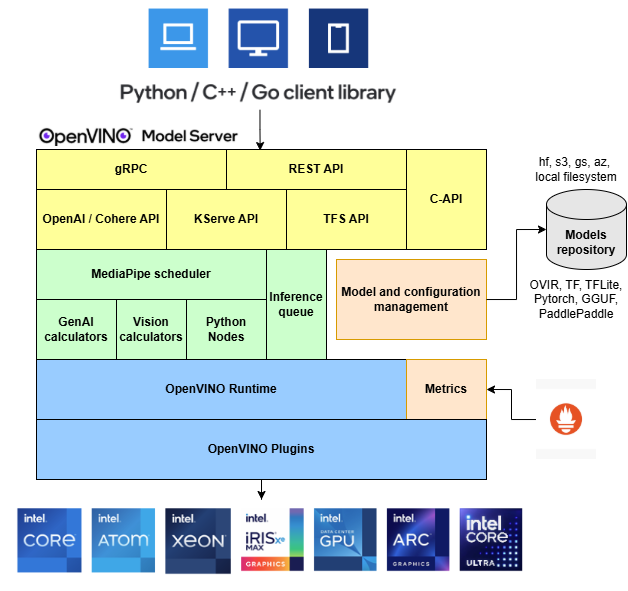
OpenVINO Model Server (OVMS) is a production-grade, C++ inference server that exposes ML models over standard network APIs. It serves both Generative AI, Agentic workloads (LLMs, VLMs, image generation, audio) and classic deep learning models (object detection, classification, OCR, and more).
OpenAI-compatible API for text generation, embeddings, image generation, and audio
KServe APIs for classic model inference
Runs anywhere — Docker, bare metal, Kubernetes/OpenShift, Windows
Intel-optimized — CPU, GPU, NPU acceleration via OpenVINO
Quick Start#
Serve an LLM with OpenAI-compatible API#
On Linux (Docker):
mkdir -p ${HOME}/models
# Model is downloaded automatically from HuggingFace to models folder
docker run --rm -p 8000:8000 \
  --user $(id -u):$(id -g) -v ${HOME}/models:/models:rw \
  openvino/model_server:latest \
  --source_model OpenVINO/Qwen3-4B-int4-ov \
  --model_repository_path /models \
  --rest_port 8000
For GPU acceleration, use the
latest-gpuimage tag and pass--device /dev/dri --group-add $(stat -c '%g' /dev/dri/render* | head -n1)to expose the Intel GPU device.
On Windows (binary package):
mkdir c:\models
ovms.exe --source_model OpenVINO/Qwen3-4B-int4-ov --model_repository_path c:\models --rest_port 8000
Query the model:
pip install openai
from openai import OpenAI

client = OpenAI(base_url="http://localhost:8000/v1", api_key="unused")
stream = client.chat.completions.create(
    model="OpenVINO/Qwen3-4B-int4-ov",
    messages=[{"role": "user", "content": "What are the 3 main tourist attractions in Paris?"}],
    stream=True,
    extra_body={"chat_template_kwargs": {"enable_thinking": False}}
)
for chunk in stream:
    if chunk.choices[0].delta.content:
        print(chunk.choices[0].delta.content, end="", flush=True)
Serve a Classic Model with KServe API#
Download the model:
curl -L https://huggingface.co/OpenVINO/resnet50-int8-ov/resolve/main/resnet50.bin -O
curl -L https://huggingface.co/OpenVINO/resnet50-int8-ov/resolve/main/resnet50.xml -O
On Linux (Docker):
docker run --rm -d -u $(id -u) -v ${PWD}:/models -p 9000:9000 \
  openvino/model_server:latest \
  --model_name resnet --model_path /models/resnet50.xml \
  --mean "[123.675,116.28,103.53]" --scale "[58.395,57.12,57.375]" --layout "NHWC:NCHW" \
  --port 9000
For GPU acceleration, use the
latest-gpuimage tag and pass--device /dev/dri --group-add $(stat -c '%g' /dev/dri/render* | head -n1)to expose the Intel GPU device.
Windows (binary package):
ovms --model_name resnet --model_path resnet50.xml --mean "[123.675,116.28,103.53]" --scale "[58.395,57.12,57.375]" --layout "NHWC:NCHW" --port 9000
Run inference with a sample python client
pip install numpy tritonclient[grpc]
curl -L -o image.jpeg https://github.com/openvinotoolkit/model_server/blob/releases/2026/4/demos/common/static/images/bee.jpeg?raw=true
import numpy as np
import tritonclient.grpc as grpcclient
with open("image.jpeg", "rb") as f:
    image_bytes = f.read()
client = grpcclient.InferenceServerClient(url="localhost:9000")
inputs = [grpcclient.InferInput("image", [1], "BYTES")]
inputs[0].set_data_from_numpy(np.array([image_bytes], dtype=object))
outputs = [grpcclient.InferRequestedOutput("output")]
result = client.infer(model_name="resnet", inputs=inputs, outputs=outputs)
output = result.as_numpy("output")  # (1, 1000) FP32
print("Top-1 class index:", int(np.argmax(output[0])))
Features#
Generative AI#
LLM text generation — continuous batching, streaming, structured output, speculative decoding
Text embeddings — OpenAI-compatible
/v1/embeddingsReranking — Cohere-compatible API
Image generation — OpenAI-compatible
/v1/images/generationsSpeech recognition and TTS — OpenAI-compatible audio API
Classic Models & Pipelines#
TensorFlow, ONNX, PaddlePaddle, OpenVINO IR model formats
Deployment & Integration#
Docker, bare metal (Linux & Windows), Kubernetes / OpenShift
Model repository: local storage, S3, GCS, Azure Blob, HuggingFace Hub
C API for embedding OVMS in native applications
Hardware Acceleration#
CPU (x86, including Xeon), Intel integrated and discrete GPU, NPU
Documentation#
Topic |
Link |
|---|---|
Deployment |
|
Model repository |
|
Client libraries |
|
Demos & examples |
|
Release notes |
Get the Server#
Docker images (recommended):
docker pull openvino/model_server:latest        # Intel CPU
docker pull openvino/model_server:latest-gpu    # Intel CPU,GPU,NPU
Binary packages (Linux & Windows): GitHub Releases
Contributing#
Contributions are welcome! Please open an issue or pull request on GitHub.
See security policy for responsible disclosure.
References#
* Other names and brands may be claimed as the property of others.